Cross Market AI sounds like the kind of tool many traders want right now: one dashboard that connects stocks, crypto, forex, commodities, macro news, and market sentiment into a single AI-powered view.
That idea is useful. Markets do not move in isolation. A stronger U.S. dollar can pressure gold, rising bond yields can affect growth stocks, and sudden crypto weakness can reflect broader risk-off sentiment. A good cross-market analytics tool can help traders see those relationships faster.
But there is a big difference between cross-market AI as a trading concept and a specific platform using the Cross Market AI or CrossMarket AI name. The concept is real. The platform needs much closer checking.
This review explains what Cross Market AI claims to do, how cross-market trading analysis works, the warning signs users should check, and whether it looks safe enough to trust with money.
Important note: This article is for educational purposes only. It is not financial advice. Trading and investing involve risk, and no AI tool can guarantee profit.
Quick Verdict
Question
Answer
Is cross-market AI a real concept?
Yes. Multi-asset analysis, machine learning, risk models, and correlation tracking are widely used in modern finance.
Does that make every Cross Market AI platform safe?
No. A real concept can still be used in risky or misleading platforms.
Should beginners deposit money quickly?
No. Users should first verify regulation, ownership, withdrawals, fees, and real performance proof.
Biggest concern
Platforms promising fixed or unusually high returns, unclear ownership, or difficult withdrawals should be treated as high risk.
Better use case
Use AI market tools for research, alerts, and context—not as a blind auto-trading system.
What Is Cross Market AI?
Cross Market AI trading refers to artificial intelligence systems that analyze price action, volume, sentiment, macroeconomic indicators, and volatility across multiple financial markets at once.
Traditional trading strategies often focus on a single market: stocks, crypto, forex, or commodities. Cross Market AI expands that lens. It treats markets as an interconnected network rather than independent systems.
Modern AI trading systems rely on machine learning models, deep neural networks, and reinforcement learning to process vast datasets in real time . These models continuously learn from cross-asset behavior and adapt when correlations shift.
In simple terms, instead of asking:
“What is gold doing today?”
Cross Market AI asks:
“How is gold reacting to bond yields, the dollar index, inflation expectations, and crypto volatility — and what does that combined signal suggest?”
How Cross Market AI Trading Works
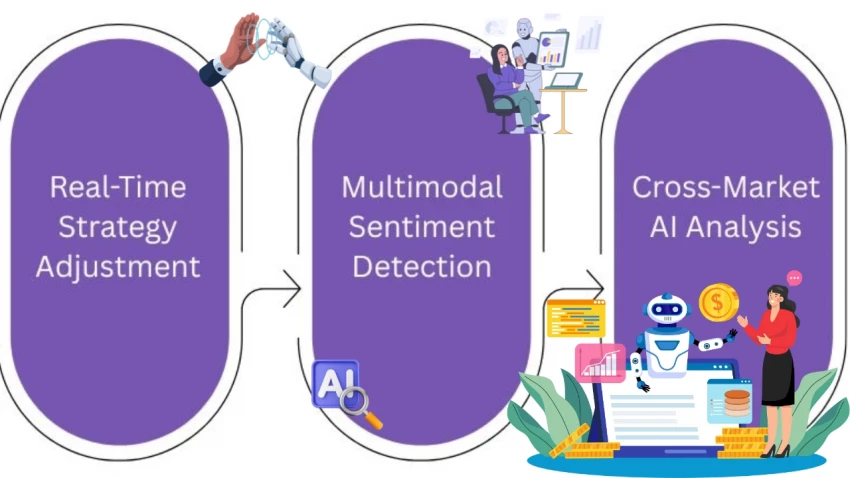
A proper cross-market AI system usually works in three stages.
1. Data Collection
The system gathers market data from different asset classes. This may include price movement, trading volume, volatility, interest rates, macroeconomic releases, and news sentiment.
The better the data quality, the more useful the output can be. Poor data, delayed data, or limited market coverage can make the AI signals unreliable.
2. Pattern Detection
Machine learning models look for relationships between markets. For example, the system may detect that when Treasury yields rise sharply, growth stocks and crypto assets often become more volatile.
But this does not mean the relationship will always repeat. One of the biggest mistakes traders make is treating past correlation as guaranteed future behavior.
3. Signal or Alert Generation
After analyzing the data, the tool may generate alerts, risk warnings, or trading signals.
A responsible platform should explain how signals are created, what data is used, and what limitations exist. A risky platform may simply show “buy,” “sell,” or “guaranteed profit” messages without enough explanation.
Real Example: Why Multi-Market Context Matters
Imagine this situation:
The Federal Reserve signals that interest rates may stay higher for longer. Bond yields rise. The U.S. dollar strengthens. Gold weakens. Technology stocks become more volatile. Bitcoin starts falling.
A single-market trader may only see Bitcoin dropping and assume it is a crypto-specific move. A cross-market system may show that the move is part of a broader risk-off reaction across multiple assets.
That context matters. It can help traders avoid making decisions based on one isolated chart.
Still, context is not certainty. A cross-market signal should be treated as one input, not a final decision.
Key Features That Stand Out
Several features make cross-market platforms distinct from traditional trading tools:
Cross-Market Correlation Tracking The system highlights how assets move together or diverge. For example, gold’s performance may begin to mirror cryptocurrency movements during periods of high inflation.
Real-Time Trading Signals Artificial intelligence can generate alerts based on market data. These signals aren’t guaranteed to be correct, but they provide timely cues that may be useful for decision-making.
Intuitive Dashboards A clean interface allows traders to zoom in on one sector or scan across markets without being overwhelmed by data overload.
Backtesting Capabilities Signals can be tested against historical data before acting on them. This helps users evaluate reliability rather than relying on guesswork.
An Example in Practice
Consider gold prices rising during inflationary periods. A cross-market system may flag that digital assets like Ethereum tend to respond in parallel. Traders looking only at cryptocurrency charts might miss that connection.
By surfacing such relationships, AI-driven platforms expand visibility. They don’t eliminate uncertainty, but they reduce blind spots that come from monitoring markets in isolation.
Why Cross-Market AI Matters Beyond Trading
The value of connecting data across silos isn’t limited to financial markets. In healthcare, cross-domain AI could combine patient records with supply chain data. In climate research, it might link environmental changes to commodity pricing.
Benefits
Challenges
Broader insights across multiple domains
Complex AI models can be difficult to interpret
Innovation through unexpected connections
Overreliance on AI may reduce human judgment
More informed and data-driven decisions
Transparency and ethical concerns remain unresolved
Faster pattern recognition and analysis
Bias and inaccurate outputs can still occur
Improved efficiency in research and workflows
Accountability in AI-driven decisions is often unclear
Practical Tips for Using Cross-Market Insights
For traders or analysts exploring multi-market AI, a few steps help make the most of it:
Start with one or two sectors rather than tracking everything at once.
Use alerts selectively to avoid information overload.
Treat signals as guidance, not certainty.
Backtest strategies before acting.
Combine AI insights with traditional analysis for balanced decisions.
The goal is not prediction perfection but contextual awareness; seeing how different pieces of the market puzzle fit together.
Who Benefits Most From Cross-Market AI?
User Type
Value Level
Institutional traders
High
Hedge funds
Very High
Retail swing traders
Moderate
Long-term investors
Moderate
Beginners
Limited without guidance
Cross Market AI Trading Reviews
When researching Cross Market AI trading platforms online, you’ll find a mix of user-generated reviews and critical analyses, some describing real experiences, others raising serious caution flags.
Positive User Experiences
Some traders report that platforms claiming to offer cross-market insights helped them think about market relationships more broadly.
One review describes using Cross Market AI to track relationships between commodities and crypto, helping the reviewer to reconsider trades with more context and data-driven awareness rather than gut intuition. Users noted the dashboard was simple and visually clear, making it easy to explore different asset classes together.
On community review sites like Trustpilot, some users give mostly positive ratings, with several commenting that the platform felt approachable and useful for visualizing market dynamics.
These reviews highlight that analytics that unify multiple markets can be a valuable perspective for traders interested in broader trading patterns.
Warnings, Red Flags & Risk Themes
However, a number of online articles and watchdog sites have expressed serious concerns about platforms operating under the “Cross Market AI” name, especially those that promise unrealistic returns or feature opaque operations:
Unrealistic Return Claims
Several sources note that some platforms marketing themselves as “Cross Market AI” suggest high guaranteed returns (e.g., 0.5%–1% daily or 15–30% monthly), which financial experts say should immediately raise skepticism because such consistent performance is extremely improbable in real markets.
Lack of Transparency
Investigations into some Cross Market AI branded entities show no clear evidence of real AI trading algorithms, regulatory licenses, or audited performance data, elements that are considered basic requirements for legitimate trading platforms.
Scam Allegations and Reports
Some reviews and analysis sites categorize particular incarnations of CrossMarket AI as high-risk or potentially fraudulent, citing:
Hidden ownership and proxy registration
Absence of regulatory licensing (e.g., no SEBI, SEC, FCA registration)
Reports of withdrawal difficulties or blocked accounts
Use of referral or pyramid-like recruiting language
These are common indicators associated with high-yield investment program (HYIP) scams rather than regulated trading services.
Expert Views on AI Trading Hype
Beyond specific platform reviews, financial commentators warn that while AI tools can offer real analytical value, many services labeled as “AI trading platforms” simply use buzzwords without delivering genuine machine learning-based execution or risk management. Analysts emphasize that true AI trading typically requires transparent mechanisms, robust historical testing, and rigorous risk controls, none of which are visible in many Cross Market AI offerings.
Is Cross Market AI Trading Legitimate?
Is Cross Market AI Legit?
The safest answer is: the concept is legitimate, but any specific platform must be verified carefully.
Cross-market AI analysis is real. Institutional traders, hedge funds, and quantitative research teams do use multi-asset data, machine learning, and risk models.
However, that does not automatically make every website using the name “Cross Market AI” legitimate. A platform can use real finance language while still being unsafe, unregulated, or misleading.
Before depositing money, check:
Is the company legally registered?
Is it regulated in your country?
Can you verify the team behind it?
Are withdrawals working for normal users?
Does the platform avoid guaranteed-profit claims?
Does it explain risks clearly?
Does it provide audited or independently verifiable results?
For U.S.-related investment professionals, users can check registration and disciplinary history through Investor.gov, IAPD, or FINRA BrokerCheck. For India, users can check SEBI-recognized intermediaries and use SCORES for complaints related to SEBI-regulated entities. For the UK, users can check whether a firm is authorised through the FCA register or firm checker.
My Rating: Cross Market AI
Category
Rating (out of 5)
Notes
Ease of Use
4.0
Dashboard-based, beginner-friendly
Features
4.2
Covers multi-market insights and signals
Accuracy
3.5
Helpful but not always consistent
Value for Money
4.0
Works better for active traders
Transparency
3.0
Limited clarity on backend/data
Support
3.0
Mixed user feedback
Overall Rating
3.8
Useful, but not fully reliable alone
Better Ways to Use Cross-Market AI Safely
If you want to use AI for trading research, use it carefully.
Start with these rules:
Safe Practice
Reason
Use demo mode first
Avoid risking real money before testing the tool.
Track signal accuracy manually
Do not rely on marketing claims.
Compare signals with your own analysis
AI can be wrong or delayed.
Avoid platforms promising fixed returns
Fixed profit claims are a major warning sign.
Never deposit money you cannot afford to lose
Trading is risky even with good tools.
Keep screenshots and records
Helpful if withdrawal or support problems occur.
Verify regulation before funding
Regulation does not guarantee safety, but lack of it increases risk.
The most practical use of cross-market AI is not “make money while doing nothing.” It is better used as a research assistant that helps traders understand what is happening across markets.
Wrapping It All Together
Cross Market AI shows how artificial intelligence can broaden perspective in trading and beyond. By revealing hidden links between markets, it helps reduce blind spots and opens space for new strategies.
It’s not a magic solution, nor does it guarantee outcomes. But as a tool for understanding how different markets interact, it reflects a wider shift in how AI is being used: not just to analyze one dataset, but to connect many.
The real question is less about whether AI can predict markets perfectly and more about what new patterns emerge when connections are finally visible.
FAQ Section
What is Cross Market AI trading? It is an AI-driven trading approach that analyzes multiple financial markets simultaneously to detect intermarket patterns and correlations.
How is Cross Market AI different from algorithmic trading? Algorithmic trading can operate in a single market. Cross Market AI specifically integrates data across multiple asset classes.
Do hedge funds use Cross Market AI trading? Yes. Many quantitative funds use multi-asset AI systems to detect correlations and manage risk exposure.
Is Cross Market AI trading risky? Like all trading strategies, it carries risk. Its advantage lies in improved awareness of cross-asset relationships.
Can retail traders use Cross Market AI? Retail traders can use AI-powered analytics tools, though building full institutional-grade systems requires advanced infrastructure.
"I expected more accuracy from the signals. Sometimes they make sense, but other times they feel off or delayed. You can’t fully trust it without double-checking everything.
The cross-market insights are actually useful if you understand trading basics. I noticed patterns I would’ve missed otherwise, especially how global events impact different assets. Feels more like a smart assistant than just another chart tool.