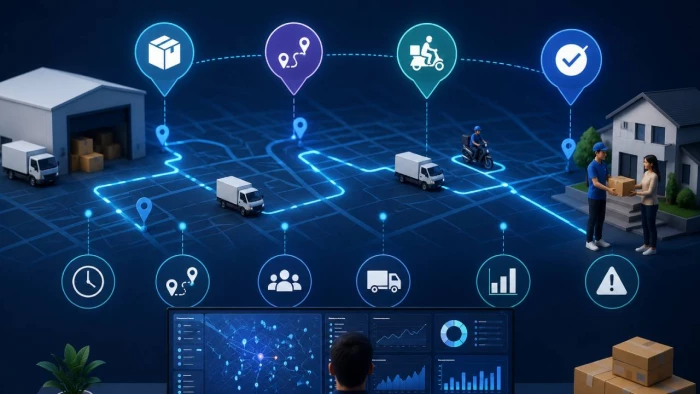
Last mile delivery is where enterprise logistics faces its toughest test. Routes planned in the morning can fall apart when traffic shifts, carriers miss scans, customers request updates, or exceptions stay hidden until the delivery window is already at risk.
For dispatchers, operations leaders, and customer support teams, these gaps create more than delays. They increase WISMO calls, raise costs, weaken SLA performance, and reduce customer confidence.
A modern last mile delivery solution must connect planning, execution, visibility, exception recovery, carrier coordination, and communication in one workflow. The aim is to give teams tighter control over every route, driver, carrier, and customer touchpoint while improving delivery speed.
Let's understand the 10 operational gaps that the last mile delivery solution must fix for enterprises before they compound at scale and repeat.
A modern last mile delivery solution should connect planning, execution, visibility, and recovery into one operational workflow. These gaps show where enterprise delivery networks often lose control, efficiency, and customer trust.
1. Fixed Route Plans That Break Before Midday
Fixed route plans built at dispatch cannot account for real-world disruption once routes go live. Traffic incidents, access restrictions, and order changes can invalidate even well-constructed plans within hours.
A capable last mile delivery solution must support dynamic re-sequencing during active execution, without forcing a full replanning cycle. Mid-shift flexibility directly protects SLA compliance at the stop level.
2. WISMO Calls That Overwhelm Customer Support Teams
"Where is My Order?" (WISMO) remains one of the most common support categories in last mile operations. Each inbound WISMO call usually signals a visibility gap somewhere in the delivery workflow.
Proactive customer communication, triggered by real-time stop-level status, is a foundational feature any last mile delivery solution must deliver. Better visibility helps reduce support pressure and improves customer confidence during delivery.
3. No Unified Visibility Across Multi-carrier Networks
Most enterprise networks operate across owned fleets, contracted carriers, and gig delivery partners at the same time. Without a unified visibility layer, dispatchers cannot monitor SLA exposure across carrier tiers in real time.
A last mile delivery solution operating at network scale must aggregate carrier tracking data, stop-level status, and ETA variance into one control view. Siloed carrier data creates exceptions that can damage client relationships at scale.
4. Manual Exception Management That Slows Recovery Time
Exceptions in last mile delivery, including failed attempts, access denials, and damaged consignments, require fast and structured responses. Manual exception workflows depend on dispatcher attention, phone calls, and fragmented logging.
An enterprise-grade last mile delivery solution should automate exception detection, trigger recovery workflows, and route exception data back into planning for future improvement. Faster recovery helps teams reduce disruption across high-volume routes.
5. Carrier Allocation Based on Rate Alone, not Performance
Rate-only carrier selection is a structural margin risk in last mile operations. Carriers with lower per-stop costs may underperform on OTIF, first-attempt delivery rates, or proof-of-delivery compliance.
Rate-based routing, integrated with live carrier performance scorecards, allows a last mile delivery solution to allocate volume using cost, speed, and reliability. This approach helps protect SLAs without depending only on the lowest available carrier rate.
6. Disconnected Planning and Execution Data
When route planning and field execution run on separate systems, variance data never feeds back into future planning cycles. Dispatchers cannot identify underperforming stop clusters, high-risk driver zones, or carrier lanes with repeated SLA exposure.
A last mile delivery solution must close this feedback loop by connecting real-time execution data directly to the planning layer. This creates the foundation for continuous route quality improvement.
7. Proof-of-Delivery (PoD) Gaps and Compliance Documentation Failures
In B2B and regulated delivery environments, PoD is both a contractual and compliance requirement. PoD failures, such as missing signatures, unverified recipient IDs, or incomplete timestamped records, create dispute risk and slow invoice processing.
A robust last mile delivery solution must support digital PoD capture, email OTP verification, one-scan pallet verification at hub dispatch, and real-time PoD sync to OMS and ERP systems. Compliance documentation cannot be an afterthought at enterprise volume.
8. Capacity Overloading During Active Dispatch Windows
Vehicle capacity violations discovered after dispatch create delivery failures that are entirely avoidable. Real-time capacity alerts, triggered at the order and SKU level during route construction, help prevent overloading before routes are released.
Any last mile delivery solution operating at enterprise scale should enforce capacity compliance dynamically, not as a post-dispatch audit. Overloaded routes create cascading failures that can affect multiple shifts.
9. Driver Assignment That Ignores Skill, Zone, and Compliance Requirements
Assigning any available driver to any route is a throughput and compliance risk. Specialized deliveries, including hazardous materials, high-value consignments, and multi-part stops, require skill-matched driver assignment within the dispatch workflow.
A last mile delivery solution with skill-based assignment logic ensures driver capabilities, zone familiarity, license classifications, and HOS compliance are validated before every route is released to the field.
10. No Predictive Risk Visibility Before SLAs Breach
Most last mile operations identify SLA risk only after a delivery has already failed. Predictive risk visibility, powered by real-time stop progress, historical delivery patterns, and live traffic data, allows dispatchers to intervene before the SLA window closes.
The difference between reactive and predictive exception management appears in OTIF performance, customer satisfaction, and re-delivery costs. A last mile delivery solution that flags at-risk orders during active execution gives dispatchers time to act, not just react.
These ten bottlenecks do not operate in isolation. WISMO volume increases when proof of delivery fails. Capacity violations compound when carrier allocation ignores performance data. Fixed route plans collapse faster when exception management is manual. The operational debt accumulates shift by shift.
Enterprises that treat last mile delivery as a systems problem, not just a logistics problem, resolve these gaps structurally. With technology partners such as FarEye, operations teams gain AI-based routing, real-time control tower visibility, and predictive exception management across every carrier tier. That combination transforms last mile delivery from a daily firefighting exercise into a measurable competitive advantage.
Share your thoughts about this article.
Be the first to post a comment!
A standard health insurance policy is excellent for covering inpatient hospitali...
Kruzel6 days ago

The stakes for online visibility have never been higher. As we move through 2026...
Kruzel3 weeks ago

Choosing a healthcare provider for your family is a matter of weighing clinical...
Terri Cruz3 weeks ago

Dubai is no longer just adopting AI — it is mandating it. In 2026, the city's le...
Kruzel4 weeks ago

Buying a house in the UK is a big milestone, but it’s also a hidden layer of com...
Techie Frog1 month ago

Choosing a Forex trading platform is not just about picking the one with the mos...
Kruzel1 month ago