Software releases are always tense for modern businesses. Miss one bug and suddenly you’re dealing with outages, security holes, angry customers, and a reputation you can’t fix overnight.
Development moves faster than ever; systems are tied together in ways that leave no room for mistakes, and the pressure just keeps climbing.
Still, plenty of organizations watch releases spiral out of control – delays, last minute patches, endless fixes after launch. The problem usually isn’t a lack of smart people. It’s weak testing and scattered quality checks.
Test-driven delivery flips the script. Instead of treating quality as a box to check at the end, it weaves testing into every stage of development.
You can’t build reliable software without real, structured testing. Even the best designs fall apart if you don’t see how they handle real-world chaos.
A lot of companies lean on trusted QA and testing service providers, especially when their own teams are stretched thin or need specialized skills. Partner companies help create scalable testing strategies, allowing for quick releases that don't fall apart.
Good testing pays off immediately. Code gets sturdier. Teams trust their deployments. Users stop complaining. Security holds up. Maintenance doesn’t become a nightmare.
When you start testing early, you catch problems before they turn into disasters. Suddenly, quality isn’t just firefighting – it's a strategic advantage.
Test-driven delivery borrows from test-driven development (TDD), but it goes further. It covers the whole delivery pipeline.
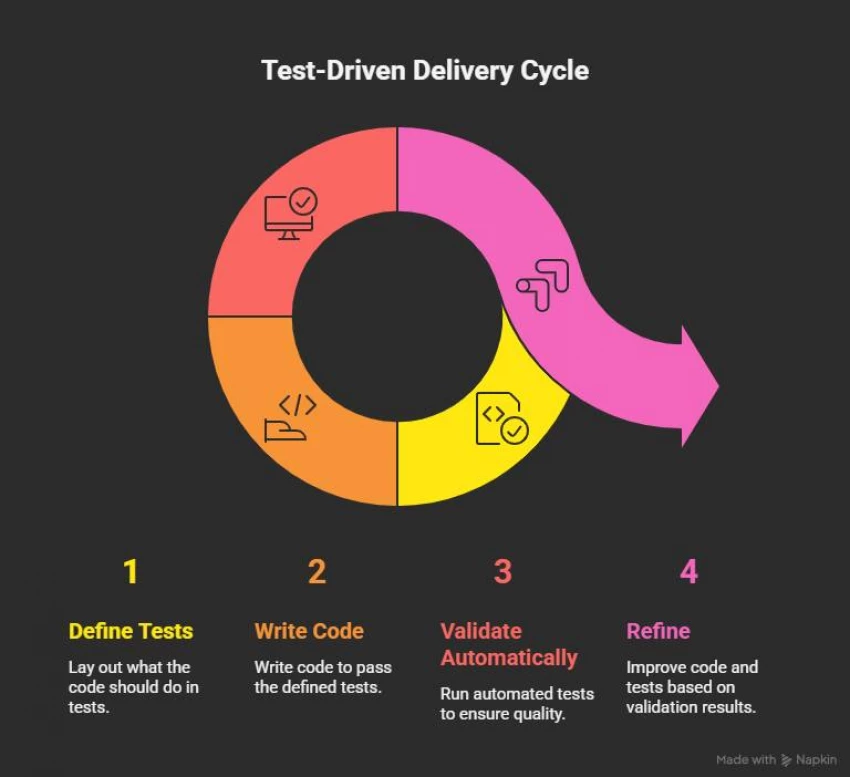
Forget writing code first and scrambling to test later. The process looks like this:
Following this process allows you to test every new feature from the get-go. Developers know what they’re aiming for. Product managers can see where things stand, instead of guessing.
Test-driven delivery keeps releases steady. Every release hits the same quality bar, so you don’t get weird surprises at the finish line.
Making test-driven delivery only works if testing isn’t an afterthought. It has to be part of the daily grind.
The best teams build testing into:
Unit tests, integration tests, system tests – they all run themselves whenever someone pushes new code. Feedback happens right away, so bad code can’t sneak through.
When testing is just part of the workflow, not some extra chore, quality goes up, and teams don’t lose momentum.
Every code change brings risk. Even a tiny tweak can break things in ways nobody expects.
Continuous validation keeps that risk in check. Rather than waiting for a big test phase, teams check everything in small bites, all the time.
A solid validation routine includes:
This approach makes failures obvious and easy to track down. You catch issues where they start, implement quick fixes, and don’t pile up technical debt.
One of the biggest reasons releases go off the rails is simple – teams are siloed. Developers do their thing. Testers do theirs. No one talks enough.
Test-driven delivery demands real collaboration. Developers, QA engineers, product managers, and DevOps specialists all share the load. When everyone owns quality, developers care more about testing and QA teams get a clearer look at how the system actually works.
This kind of teamwork delivers:
Quality becomes everyone’s job – not just QA’s problem. That’s how releases start to run smoothly.
Modern test-driven delivery leans hard on automation. Manual testing just can’t keep up with fast releases or the tangle of complex systems we see today.
Companies and teams implement numerous tools. Among many, there are unit testing, continuous integration, API testing, load testing, and monitoring tools.
The challenge is not to automate everything just because you can, but to prioritize what is important. Keep manual, exploratory testing around for those strange usability issues or the odd edge cases.
Technical debt silently erodes system resilience and stifles innovation. Test-driven delivery pushes back by building discipline into the process.
Properly tested code is just easier to tweak, expand, and clean up – no need to cross your fingers every time you make a change.
Testing makes it easier to identify fragile areas of the code, make it less risky to touch legacy code, and facilitates modular and incremental refactoring.
You can buy all the fancy tools you want, but if the team’s mindset isn’t right, none of it matters. Reliable delivery doesn’t come from software or gadgets – it comes from how people think and work together.
The best testing cultures spot issues early. They keep learning as they go, stay open about what’s working (and what’s not), and always look for ways to improve. That’s what moves the needle.
Leaders set the tone. If they cut corners, the whole team follows their lead. But when everyone commits to testing and quality, you see real progress. Performance just starts to click.
Be the first to post comment!

When you need to draw something with someone right now, not after sign-ups, not...
Suraj Malik1 month ago

Choosing the right software for your business can feel overwhelming. Every vendo...
Suraj Malik1 month ago

The Allure vs. the RealityIn the crowded world of online dating, SearchingForSin...
Sakshi Dhingra5 months ago

A quick look at Apkek.org shows it isn’t a true APK platform but a general tech-...
Sakshi Dhingra6 months ago

MagicLight AI is marketed as a long-form text-to-video animation platform capabl...
Vaishali6 months ago

The rise of algorithmic trading has changed how retail traders operate. But for...
Vaishali6 months ago