
Two years ago, an AI presenter on screen was a talking point. Today it is a line item in the training budget, and the question has shifted from whether the technology works to which tool suits the job.
That shift matters because these platforms are no longer interchangeable. One is built for compliance training in forty languages, another exists to pump out ad variations for paid social, and buying the wrong one is an expensive way to learn the difference.
Below is a plain comparison of four platforms that serve genuinely different needs, plus the questions worth asking before you sign anything.
● The market has split by use case. Enterprise training, workplace learning, interactive digital humans and performance advertising are now separate categories with separate leaders.
● Research is starting to back the format. A UCL study of 500 adult learners found no significant difference in engagement or retention between an AI avatar video and a human instructor video.
● Consent and compliance are the real differentiators at enterprise level, not avatar counts.
● Almost every platform now offers a free tier, so pilot before you commit to an annual contract.
● Language coverage varies enormously. Check the number against your actual markets rather than the headline figure.
The early complaint about AI presenters was the uncanny stiffness. Current models handle gesture, expression and full-body movement well enough that most viewers stop noticing within a few seconds.
The evidence is starting to catch up. Alongside the UCL research, a peer-reviewed study at USC Marshall tested AI avatar videos against human presenters across more than 250 professionals and found identical knowledge transfer between the two groups. Viewers in the UCL study completed the AI version around 20% faster.
For a business, the practical appeal is simpler. One script becomes one video, and that video becomes forty language versions without booking a studio twice.
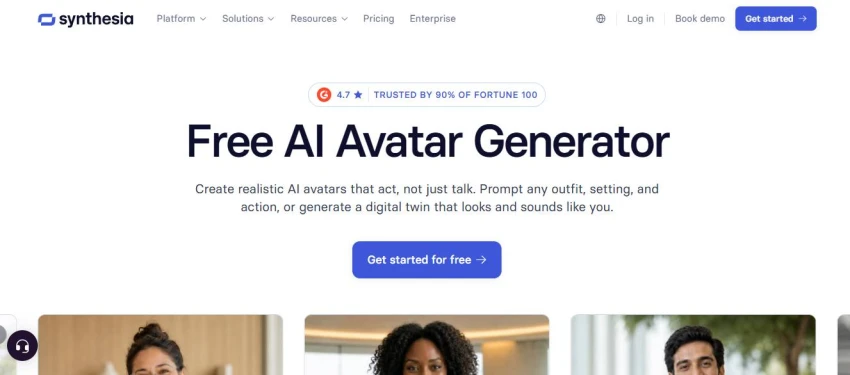
Synthesia is the option most large organisations land on, and the numbers explain why. The platform offers 240+ AI avatars, 1,000+ AI voices and video output in 160+ languages, and it reports being trusted by 90% of the Fortune 100 with over 1M users.
Governance tends to settle these shortlists more than avatar quality does. Buyers searching for the best AI avatar platform for regulated environments will find Synthesia is SOC 2 Type II, ISO 27001, ISO 42001 and GDPR compliant, with a 4.7 rating from more than 2,000 G2 reviews.
It also breaks avatars into four distinct types, which is a useful framework even if you end up choosing a different vendor:
● Stock avatars are the easiest starting point. Choose from 240+ ready-made avatars and start creating immediately, with no setup required. Best for teams who want to produce video content quickly without any configuration.
● Customizable avatars are ideal if you need the avatar to reflect a specific role, industry, or brand. Describe the outfit, setting, and actions in natural language and Veo 3 generates the scene. Best for creative, scene-based, or heavily branded visual content.
● Personal avatars are the right choice if you want video content that looks and sounds like you, without being on camera. Create your avatar from a single photo and optionally clone your voice. Best for individuals who communicate regularly and want to scale their presence across training, comms, or marketing.
● Studio avatars are for organizations that need the highest level of realism. Work with our team in a professional studio session to capture your likeness in full detail. Best for executives, spokespeople, and enterprise teams where on-screen presence and credibility matter most.
Worth noting: There is a free plan with no credit card required, which makes piloting straightforward before any procurement conversation starts.
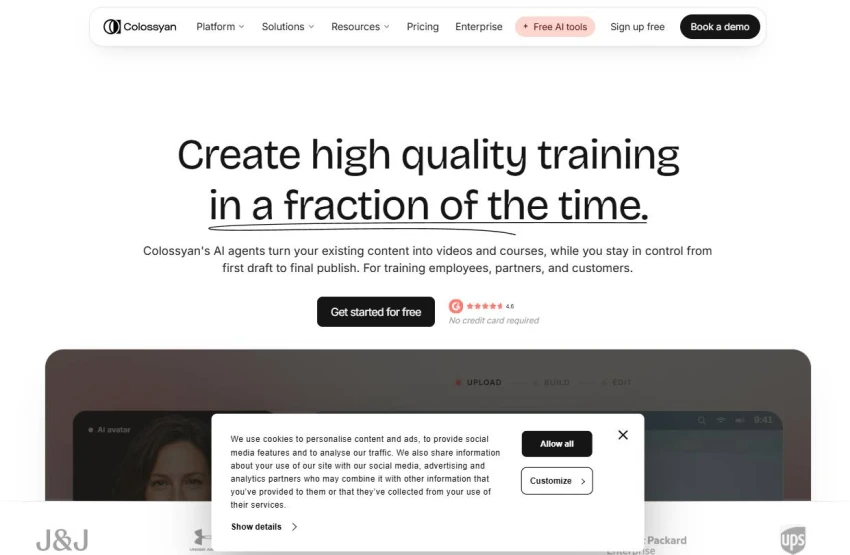
Colossyan positions itself as a full learning platform rather than a video tool, and that distinction is the whole pitch. You create avatar videos, build structured courses, add interactive elements and manage the lot in one workflow.
The platform includes 300+ AI avatars and voiceovers, video and course creation from PDFs and presentations, and localisation into 100+ languages. Version control lets you update content without re-recording.
Worth noting: SCORM export means finished courses drop straight into an existing LMS, which is the feature most general video tools simply do not have.
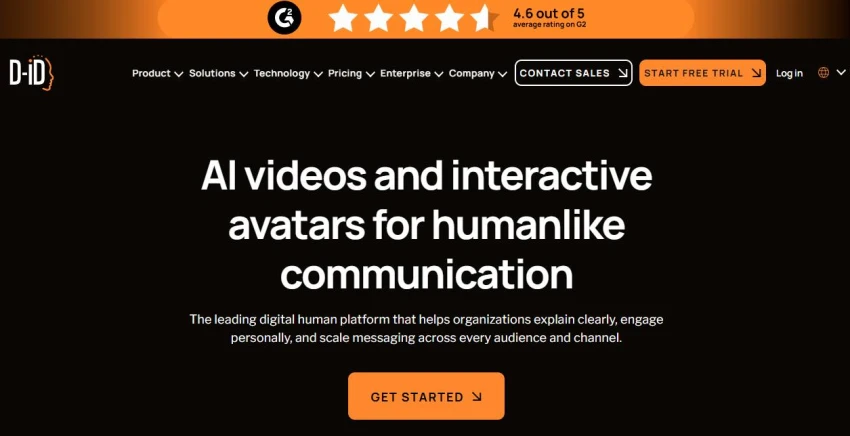
D-ID took a different route. Its Creative Reality Studio is built around deep-learning face animation, which is why it is best known for turning a still image into a speaking presenter.
The more interesting product now is AI Agents, which are real-time visual avatars that hold live conversations using an LLM. A streaming API keeps latency low, and agents can be embedded in websites, apps or learning systems.
Worth noting: Video length in the Studio and API is capped at five minutes, so this is not the tool for long-form training modules.
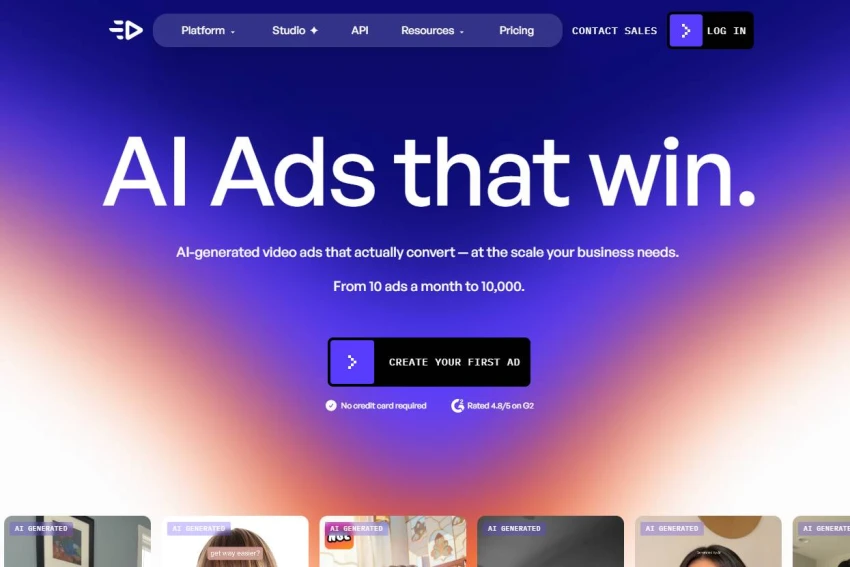
Creatify is not really competing with the others. It is an ad generator that happens to use avatars, and its core trick is turning a product URL into a finished video ad.
Its Aurora avatar model handles full-body expressiveness, 24fps lip sync and product holding, and the platform offers 140+ voices across 75+ languages. Batch mode renders 9:16, 16:9 and 1:1 simultaneously for TikTok, Meta, YouTube and Snapchat.
Worth noting: The free plan gives you 10 credits and two video ads, with watermarked exports. Fine for evaluation, not for publishing.
| Platform | Best for | Standout capability | Free tier |
| Synthesia | Enterprise training and localisation | 160+ languages with enterprise-grade compliance | Yes, no card needed |
| Colossyan | Workplace learning teams | SCORM export and course building | Self-serve plan available |
| D-ID | Interactive digital humans | Real-time conversational avatars via API | Trial available |
| Creatify | Performance advertising | URL to video ad in minutes | Yes, watermarked |
Start with the deliverable, not the demo. If you need forty compliance modules in twelve languages, avatar realism matters far less than translation quality and version control.
Then count your actual languages. Headline figures like 160+ or 75+ are meaningless if your three target markets sit outside the list, so check them individually before you commit.
Think about where video sits in your wider process too. Most teams already run some form of AI content creation across written and social channels, and a video tool that ignores that pipeline creates a second silo rather than removing one.
Finally, pilot with a real script. Vendor demos are built on polished copy, and your actual training content will expose weaknesses that a showreel never will.
If you plan to put a real person's likeness on screen, consent handling stops being a footnote. Ask how the vendor verifies it and whether that verification can be bypassed.
Synthesia, as one example, requires personal avatars to complete a live on-camera consent verification that cannot be uploaded, requires the person to be at least 18 and pays the actors behind its stock avatars each time their avatar is used. That is the standard worth benchmarking others against.
Also ask about content labelling. Disclosure requirements around AI-generated media are tightening, and a platform that already labels output saves you building that process yourself.
There is no single winner here, only a best fit for a specific job. Enterprise training and ad testing are different problems, and the tools that solve them well have diverged accordingly.
Work out which category you are actually in, pilot two options with genuine content and check the consent and compliance answers before the contract stage. The technology is good enough now that those unglamorous questions are what separate a useful purchase from an expensive one.
Do AI avatar videos actually hold viewers' attention?
The early research is encouraging. The UCL study of 500 adult learners found no significant difference in engagement or retention against a human instructor video, and the USC Marshall study found identical knowledge transfer across 250+ professionals.
Can I create an avatar of myself?
Yes, on every platform covered here. Most now build one from a single photo or a short recording, though reputable vendors will require a live consent step that you cannot skip or upload on someone else's behalf.
How much should a business expect to pay?
Pricing varies too widely to generalise, and most vendors quote enterprise tiers on request. The practical approach is to use the free or self-serve tier to establish how many video minutes you genuinely need, then negotiate from a real number.
Is AI-generated video legal to use in marketing?
Generally yes, provided you hold the rights to the likeness and voice used and you meet disclosure rules in your market. Check your vendor's consent process and whether it labels AI-generated output automatically, since that obligation increasingly sits with the publisher rather than the tool.
Share your thoughts about this article.
Be the first to post a comment!

Every occupancy sensor vendor now claims accuracy, privacy, and easy integration...
Terri Cruz2 months ago

For most enterprises, the invoice is where telecom expense management either wor...
Techie Frog3 months ago
Making a music video once devoured weekends, budgets, and barrels of coffee. Now...
Terri Cruz3 months ago
Locker manufacturing has come a long way from simple metal compartments used in...
Techie Frog3 months ago

These are the context management platforms I would shortlist when you need trust...
Kruzel4 months ago
Most businesses do not sit down one day and decide to upgrade their data stack....
Techie Frog4 months ago