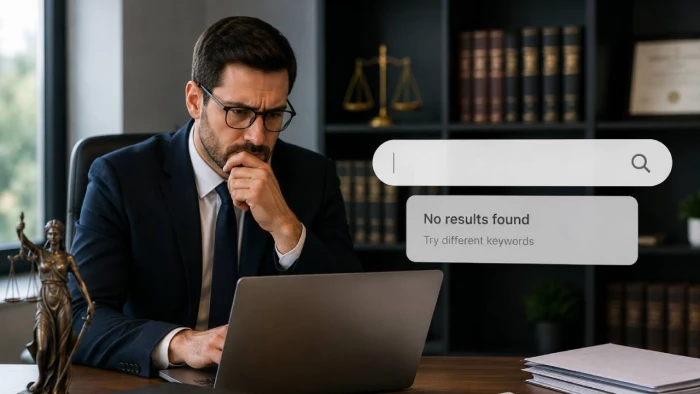
A potential client searches "car accident lawyer near me" at 11 p.m. after an argument with an insurance adjuster. Three firms show up on the first page. If your firm isn't one of them, that client never learns you exist, no matter how good your track record is. This is the reality for most legal practices: the work happens off the website, but the client relationship starts on it.
The problem is that legal search is unusually crowded and unusually expensive. Google treats legal content as "Your Money or Your Life" material, meaning it applies stricter scrutiny to anything that could affect a person's finances, freedom, or safety. That stricter standard, combined with thousands of firms bidding on the same handful of keywords, is why so many attorneys turn to SEO services for lawyers instead of trying to figure out rankings on their own. The keywords themselves are part of the problem: some personal injury terms cost over $600 per click in paid ads, and legal terms make up a disproportionate share of the most expensive keywords tracked across the web.
Here's what actually keeps a law firm off page one, and what tends to fix it.
● Thin practice area pages. A page that says "We handle car accidents" in two sentences gives Google nothing to evaluate. Pages need real depth (case types, process, timelines, and outcomes) to satisfy the trust standards Google applies to legal content.
● Inconsistent business information. If your firm's name, address, or phone number differs across your website, Google Business Profile, and legal directories, search engines lose confidence in the listing. This alone can suppress local rankings.
● No local optimization. Most legal searches carry local intent: "near me," a city name, a neighborhood. Firms that skip Google Business Profile optimization miss the local map pack entirely, which is where a large share of high-intent clicks happen.
● Weak backlink profiles. A site with no citations from bar associations, legal directories, or industry publications reads as less authoritative, and rankings reflect that.
● Slow, non-mobile-friendly sites. Most people search for legal help from a phone. A page that loads slowly or renders poorly on mobile loses visitors before they read a word.
● Reliance on paid ads alone. Ads disappear the moment the budget runs out. Organic rankings, once established, keep generating leads without a per-click cost attached to every one of them.
Fixing these problems starts with keyword research that reflects how people actually search for legal help: personal, urgent, and often tied to a city or neighborhood name, which makes the target list look different from most other industries. From there, on-page content needs enough depth to demonstrate real expertise, meaning detailed explanations of legal processes rather than keyword-stuffed summaries, written with correct terminology and within bar advertising rules.
Local visibility depends on consistency. The same business name, address, and phone number need to appear the same way on the website, the Google Business Profile, and every legal directory listing, since mismatches erode trust signals. Link building matters too, but not all links carry equal weight; a mention from a bar association or legal publication does more for a site's authority than a generic guest post.
None of this holds up without technical upkeep: fast load times, mobile optimization, and structured data that helps search engines and AI tools interpret legal content correctly. And the only way to know if any of it is working is to track it. Organic traffic and keyword position matter, but the number that counts is how many visitors turn into signed cases.
Paid search gets a firm in front of potential clients immediately, but every visitor costs money, and that cost resets the moment the campaign stops. SEO takes longer to build, often several months before meaningful movement, but each ranking, once earned, keeps producing leads without an ongoing per-click charge. Most firms that grow steadily end up running both: ads for immediate visibility while the organic strategy matures underneath it.
None of this is a one-time fix. Search algorithms shift, competitors adjust their own strategies, and a page that ranked well last year can slide without maintenance. The firms that treat search visibility as an ongoing part of running the practice, not a project with an end date, are the ones still showing up on that late-night search a year from now, when it matters most to the person doing the searching.
Share your thoughts about this article.
Be the first to post a comment!

High performers do not win solely on individual talent. They rely on good teamwo...
Terri Cruz2 weeks ago

Road safety is often discussed by looking at the size of a truck, yet the first...
Terri Cruz1 month ago

A standard health insurance policy is excellent for covering inpatient hospitali...
Kruzel1 month ago

Dubai is no longer just adopting AI — it is mandating it. In 2026, the city's le...
Kruzel2 months ago

Buying a house in the UK is a big milestone, but it’s also a hidden layer of com...
Techie Frog2 months ago

Choosing a Forex trading platform is not just about picking the one with the mos...
Kruzel2 months ago