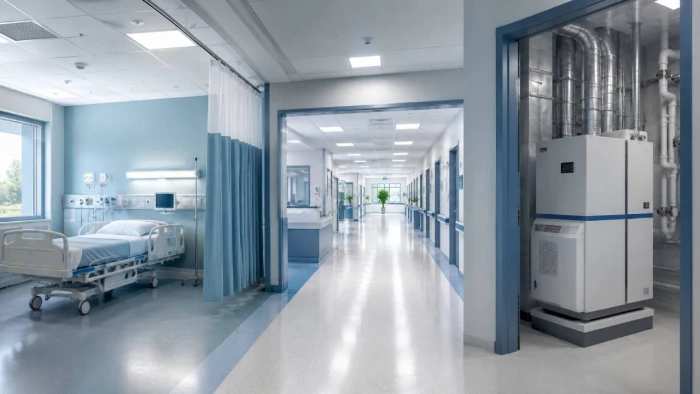
Maintaining optimal air quality is one of the most consequential and least visible responsibilities in modern healthcare facility management. Moisture levels that fall outside the recommended range create measurable risks for patients, staff, and the sensitive equipment that clinical operations depend on. The consequences of inadequate humidity control range from increased infection transmission and impaired patient recovery to equipment failure and structural degradation of the facility itself.
In this article, we examine how humidity management functions as a core component of clinical safety infrastructure. We cover the science behind optimal humidity ranges, the technical distinctions between industrial and residential systems, the role moisture plays in pathogen transmission, and the maintenance protocols required to keep humidification systems operating safely and effectively.
Key Takeaways
● Maintaining relative humidity between 40% and 60% creates a biological buffer that limits pathogen survival and protects mucosal barriers in respiratory tissue.
● Industrial humidification systems are engineered for continuous operation, high-volume air exchange, and rigorous sanitation standards that residential units cannot meet.
● Controlled humidity reduces viral persistence in the air by influencing droplet nuclei dynamics, causing infectious particles to settle rather than remain suspended.
● Neonatal and intensive care environments have specific humidity requirements that directly affect patient respiratory health, skin integrity, and recovery outcomes.
● Routine maintenance including water quality testing, sensor calibration, and deep cleaning cycles is essential to prevent humidification systems from becoming sources of microbial contamination.
The concentration of water vapor in clinical air has a direct and measurable influence on patient safety outcomes. This relationship between moisture and pathogen behaviour is well established in the medical literature, and it forms the scientific basis for the strict environmental standards that modern healthcare facilities are expected to maintain. Understanding this relationship is the starting point for appreciating why humidity management deserves the same operational priority as any other clinical safety system.
Poorly regulated air does not need to be visibly dry or uncomfortably humid to create risk. The most significant effects operate at a biological level, influencing how long pathogens survive in suspension, how effectively the body's natural defences function, and how quickly patients recover from respiratory conditions.
The healthcare industry broadly recognizes a relative humidity range of 40% to 60% as the standard for clinical environments. Within this range, the survival time of many common airborne viruses and bacteria is significantly reduced, and the conditions that support pathogen transmission are actively disrupted. Facilities that maintain air quality consistently within this band provide a measurably safer environment for both patients and clinical staff.
The following table illustrates how humidity levels outside this range affect key clinical variables:
| Humidity Level | Pathogen Survival | Patient Comfort | Equipment Risk |
| Below 30% | High | Low | High (static discharge) |
| 40% to 60% | Low | Optimal | Low |
| Above 70% | Moderate | Low | High (corrosion) |
Consistent moisture levels also stabilise the indoor environment against external weather variation, which is particularly important in areas such as operating rooms and intensive care units where atmospheric consistency is directly tied to patient and equipment safety.
The mucous membranes lining the respiratory tract serve as the body's first biological defence against inhaled pathogens. When ambient humidity falls below the recommended threshold, these membranes lose moisture and become less effective at trapping and expelling airborne contaminants. The result is a direct increase in susceptibility to respiratory infections, particularly in patients who are already immunocompromised or recovering from surgery.
For clinical environments housing vulnerable populations, the protection of mucosal barrier function is not a comfort consideration; it is a patient safety imperative. Maintaining relative humidity within the optimal range preserves the integrity of these natural defences and reduces the environmental burden placed on patients whose immune systems are already under stress.
The demands placed on humidification equipment in a hospital setting bear no resemblance to those of a residential or light commercial environment. Clinical facilities operate continuously, house populations with acute health vulnerabilities, and are subject to regulatory standards that require documented performance and hygiene compliance. Meeting these requirements demands purpose-built equipment designed from the outset for the specific challenges of healthcare infrastructure.
Understanding the technical distinctions between industrial and residential systems clarifies why a properly specified commercial humidifier for hospitals is a non-negotiable component of clinical environmental control, rather than an upgrade or optional enhancement.
Residential humidifiers are designed for intermittent use in small, enclosed spaces. They lack the capacity, durability, and hygiene engineering required to function safely in a large clinical building with continuous high-volume air exchange. In a hospital setting, an undersized or improperly specified system will fail to maintain consistent humidity levels, creating the very risks that proper humidification is intended to prevent.
Industrial humidification systems address these requirements through design features that residential units do not offer:
● Stainless steel internal components engineered to withstand continuous operation without corrosion or material degradation.
● Automated flushing cycles that prevent water from stagnating within the system, eliminating a primary source of microbial growth.
● Capacity specifications designed to manage the massive airflow volumes that large clinical buildings require to maintain regulatory compliance.
Effective humidity management in a hospital requires coordination across multiple zones with different target ranges and different sensitivity levels. Operating rooms, intensive care units, neonatal wards, and general recovery areas each require specific moisture parameters, and achieving these simultaneously demands a system that integrates cleanly with the facility's existing HVAC infrastructure rather than operating as a separate and uncoordinated layer.
Industrial humidification solutions are designed with this modular scalability in mind. Engineers configure these systems to deliver zone-specific performance without disrupting airflow balance or creating pressure differentials that affect air quality in adjacent areas. The result is a unified mechanical network in which the humidification system functions as an integral component rather than an afterthought.
Humidity management is one of the most effective and consistently underutilized tools available for hospital infection prevention. Its influence operates at a physical and biological level simultaneously, affecting both how long pathogens survive in suspension and how effectively the body is able to resist them. Facilities that manage moisture precisely create an environment that is actively hostile to pathogen transmission rather than simply neutral to it.
This section examines the specific mechanisms through which controlled humidity reduces the risk of airborne infection in clinical settings.
The relationship between ambient humidity and viral survival in air is well documented. Many airborne viruses remain infectious for significantly longer periods in dry air than in properly humidified environments. This extended survival occurs because dry air preserves the structural integrity of the viral envelope, allowing the pathogen to remain viable while suspended in the breathing zone of patients and staff.
When humidity is maintained within the optimal clinical range, the chemical environment of the air disrupts this process. The viral envelope reacts to the increased moisture, accelerating degradation and reducing the window during which the pathogen can cause infection. This mechanism represents a passive but continuous contribution to infection control that operates independently of and in addition to standard hygiene and disinfection protocols.
Bacteria respond to ambient conditions in ways that directly affect their capacity to cause infection. In dry air, bacterial particles remain suspended for extended periods, increasing the probability of inhalation by patients and staff in the affected space. Effective clinical air quality management recognizes humidity control as a tool for limiting this suspension time and reducing the concentration of viable bacteria in the breathing environment.
Several environmental factors interact with humidity to determine bacterial viability in clinical air:
● Ambient temperature fluctuations that affect the rate of moisture evaporation from bacterial particles.
● Surface moisture levels that influence whether bacteria settle on surfaces or remain airborne.
● Air exchange frequency in patient rooms, which interacts with humidity to determine how quickly contaminated air is replaced.
Respiratory droplets expelled through breathing, coughing, or speaking behave differently depending on the humidity of the surrounding air. In dry conditions, these droplets evaporate rapidly, shrinking to a concentrated residual core known as a droplet nucleus. These nuclei are small enough to remain suspended in air for extended periods and travel significant distances through a facility, carrying viable pathogens with them.
When humidity is maintained at an appropriate level, respiratory droplets retain more of their original moisture and consequently more of their original mass. This causes them to settle out of the air more rapidly, limiting the distance they travel and the duration of their infectious potential. Managing droplet nuclei dynamics through humidity control is a fundamental and scientifically grounded component of airborne infection prevention in clinical environments.
The quality of the air a patient breathes during their time in a clinical facility has a direct bearing on the speed and completeness of their recovery. This is particularly true for patients with existing respiratory conditions, those recovering from surgical procedures, and the most vulnerable populations including premature infants and critically ill adults. Humidity management in these contexts moves beyond environmental comfort and becomes a clinical intervention in its own right.
Patients in intensive care units frequently receive mechanical ventilation, which bypasses the upper respiratory tract's natural humidification function and delivers air directly to the lower airways. Without adequate moisture in the delivered air, secretions in the airways thicken, cilia function is impaired, and the risk of airway irritation and secondary infection increases. Strict ICU humidity requirements exist precisely because the consequences of inadequate moisture control in these patients are clinically significant.
Maintaining optimal humidity in intensive care environments supports the function of the cilia lining the respiratory tract, which play a critical role in clearing pathogens and debris from the lungs. For patients with chronic respiratory conditions or post-surgical airway sensitivity, this environmental support can meaningfully reduce the duration and complexity of their recovery.
Premature infants face environmental challenges that make precise humidity control a fundamental necessity rather than a clinical preference. Their skin is underdeveloped and loses moisture rapidly in dry air, creating thermal instability and increasing the risk of infection through compromised skin integrity. Neonatal care humidity targets are set to address both of these vulnerabilities simultaneously, providing conditions that support thermoregulation and skin development while limiting respiratory stress.
Pediatric wards caring for older children also benefit from consistent moisture management. Children are more susceptible to respiratory irritation from dry air than healthy adults, and their immune systems are less capable of managing the increased pathogen load that inadequate humidity permits. The table below outlines the target humidity ranges and primary clinical benefits for key care environments:
| Care Unit | Target Humidity Range | Primary Benefit | Clinical Focus |
| Intensive Care | 45% to 55% | Airway comfort | Ventilator support |
| Neonatal Ward | 50% to 60% | Skin integrity | Thermoregulation |
| General Recovery | 40% to 50% | Mucosal health | Patient comfort |
| Operating Room | 50% to 60% | Static reduction | Equipment safety |
The financial value of the equipment housed in a modern clinical facility is substantial, and its operational reliability is directly tied to patient safety in ways that make equipment protection an integral part of clinical risk management. Humidity levels that fall outside the recommended range create specific and well-understood risks to electronic systems, structural materials, and mechanical components throughout the facility.
Operating rooms contain some of the most sensitive and expensive electronic monitoring and surgical equipment in the facility. When relative humidity drops below the safe threshold, static electricity accumulates on surfaces and clothing at a rate that creates genuine risk of electrostatic discharge events. These discharges can cause data corruption, component failure, or unpredictable behavior in electronic systems during procedures where reliability is critical.
Maintaining humidity within the optimal range effectively neutralises static accumulation by providing sufficient moisture in the air to dissipate charge before it builds to a dangerous level. This passive protection mechanism operates continuously and without intervention, providing reliable electrostatic discharge prevention as a built-in consequence of proper humidity management rather than a separate safety measure.
The physical fabric of a hospital building is subject to ongoing stress from environmental conditions, and humidity levels that drift outside the acceptable range accelerate the degradation of multiple material types simultaneously. The table below outlines the specific risks that low and high humidity create for key building materials and assets:
| Material or Asset | Risk of Low Humidity | Risk of High Humidity |
| Electronic monitors | High static discharge | Internal condensation |
| Wood cabinetry | Cracking and warping | Mold and swelling |
| Metal HVAC ducts | Increased dust buildup | Corrosion and rust |
| Surgical instruments | Static interference | Oxidation of surfaces |
Industrial-grade humidification systems that maintain consistent moisture levels protect the facility from both extremes simultaneously, preserving the structural integrity of the building and the operational reliability of its assets over the long term.
A humidification system that is not properly maintained does not simply underperform; it actively creates risk. Stagnant water, biofilm accumulation, and inadequate filtration can transform a system designed to protect patients into a source of microbial contamination. Rigorous maintenance protocols are therefore not an operational preference but a patient safety requirement.
The internal components of a humidification system, including distribution pans, nozzles, and water reservoirs, provide surfaces on which biofilm can develop if cleaning cycles are inadequate or irregular. Biofilm formations harbour bacteria that are then dispersed into the clinical environment through the very air the system is designed to treat. Preventing this requires a combination of regular deep cleaning, automated flushing to eliminate stagnant water, and high-quality filtration that captures contaminants before they reach the air stream.
Ultraviolet light treatment integrated into the water supply pathway provides an additional barrier against microbial development, inactivating organisms that pass through the system between scheduled cleaning cycles. This technology functions as a continuous passive safeguard that supplements rather than replaces the scheduled maintenance programme.
Water used in clinical humidification systems must meet defined quality standards and be tested regularly to verify compliance. The primary concern is the prevention of Legionella and other waterborne pathogens that can proliferate in inadequately managed water systems and cause serious respiratory illness when dispersed into the air. Automated sensors that provide real-time monitoring of water chemistry allow facility teams to identify and respond to deviations before they create clinical risk.
The table below outlines the essential maintenance tasks required to maintain system safety and compliance:
| Maintenance Task | Frequency | Primary Objective | Responsible Party |
| Water quality testing | Weekly | Pathogen detection | Lab technician |
| Sensor calibration | Monthly | System accuracy | Facilities engineer |
| Deep cleaning cycle | Quarterly | Biofilm removal | Maintenance crew |
| Filter replacement | Every six months | Air purity | HVAC specialist |
Integrating these tasks into a documented maintenance schedule with clear accountability ensures that compliance can be verified and that no critical step is deferred or overlooked during periods of operational pressure.
Humidity management is a foundational element of clinical safety infrastructure that operates continuously and influences patient outcomes, infection control, equipment reliability, and facility integrity simultaneously. Facilities that invest in properly specified and rigorously maintained industrial humidification systems create a measurably safer environment for patients and staff while protecting the significant capital investment represented by modern medical equipment and building infrastructure.
The evidence base supporting optimal humidity ranges in clinical settings is well established, and the operational framework for maintaining those ranges through appropriate technology and maintenance protocols is clearly defined. For healthcare administrators, the decision to prioritise humidity control is one of the clearest and most well-supported investments available in clinical environmental safety.
This range creates a biological buffer that limits the survival time of many airborne pathogens while preserving the moisture content of respiratory mucosal membranes. Below 40%, dry air compromises the body's natural respiratory defences and allows viral and bacterial particles to remain suspended longer. Above 60%, the risk of condensation, mould growth, and corrosion of metal components increases. The 40% to 60% range balances all of these considerations simultaneously.
Industrial systems are engineered for continuous high-volume operation, rigorous sanitation compliance, and integration with large-scale HVAC infrastructure. They incorporate stainless steel components, automated flushing cycles, and advanced filtration that residential units do not provide. These features are not optional enhancements; they are requirements for safe and effective operation in a clinical environment where system failure or contamination has direct patient safety consequences.
Controlled humidity influences droplet nuclei dynamics by causing respiratory droplets to retain moisture and settle out of the air more rapidly rather than evaporating into smaller particles that remain suspended. It also directly affects viral envelope stability and bacterial suspension time, reducing the viability and travel distance of airborne pathogens throughout the facility.
Intensive care units target a relative humidity range of 45% to 55% to support airway comfort in ventilated patients and maintain effective cilia function in the respiratory tract. Neonatal wards require 50% to 60% to protect the underdeveloped skin of premature infants and support thermoregulation. These ranges are set to address the specific clinical vulnerabilities of each patient population.
Key protocols include weekly water quality testing for pathogens including Legionella, monthly sensor calibration to ensure accurate monitoring, quarterly deep cleaning cycles to remove biofilm from internal components, and filter replacement every six months. Automated flushing systems and ultraviolet light treatment provide continuous passive protection between scheduled maintenance interventions. All tasks should be assigned to named responsible parties and documented for compliance verification.
Share your thoughts about this article.
Be the first to post a comment!

High performers do not win solely on individual talent. They rely on good teamwo...
Terri Cruz6 days ago

A potential client searches "car accident lawyer near me" at 11 p.m. after an ar...
Terri Cruz1 week ago

Road safety is often discussed by looking at the size of a truck, yet the first...
Terri Cruz3 weeks ago

A standard health insurance policy is excellent for covering inpatient hospitali...
Kruzel1 month ago

Choosing a healthcare provider for your family is a matter of weighing clinical...
Terri Cruz1 month ago

Dubai is no longer just adopting AI — it is mandating it. In 2026, the city's le...
Kruzel2 months ago